
|
| Bust identified as Aristophanes, Roman copy of a Greek original. Uffizi Gallery, Florence. |
No portrait of Aristophanes survives from his own lifetime. Busts like this one were carved centuries later, guesses at a face nobody alive had actually seen, based only on his reputation and his plays.
|
“Our country’s fortunes depend on us… it is with us to undo utterly the Peloponnesians.”
Lysistrata, opening speech to the assembled women
|
All roles, including Lysistrata herself and every other woman in the play, were performed by men. Ancient Athenian theater didn’t allow women on stage at all, which means a play championing female political power was staged entirely by male actors in costume.
The comedy leaned hard on visual gags built around costume and props, staples of Athenian Old Comedy performance more broadly.

|
| Terracotta comic theater mask. Ancient Agora Museum, Athens. |
Male actors playing the increasingly desperate husbands wore exaggerated padded costumes, an over-the-top sight gag the entire audience would have caught instantly. The comedy was, quite literally, visible from the back row.
I used to assume ancient political satire had to be dry or moralizing to survive this long. This play is closer to a modern sketch comedy premise, executed with a genuinely radical political idea buried inside the joke.
By the play’s end, exhausted envoys from both Athens and Sparta agree to peace, aided by a young woman named Reconciliation, whose body the negotiators use, unsubtly, as a literal map of the territory in dispute.
The real Peloponnesian War dragged on for another seven years after this performance, ending in 404 BCE with Athens’s total defeat. The play’s fictional peace plan worked far faster than history’s actual one.
Twenty years of war, ended in the play in a single afternoon… by women the actual Athenian assembly wouldn’t have let vote on anything at all.
|
|
Three Things Worth Knowing
| I |
Architecture
The Acropolis
|
The building the women occupy in the play, the Athenian Acropolis, had only recently been rebuilt in Aristophanes’s lifetime. The Parthenon, its centerpiece, was completed in 432 BCE, less than a generation before this play, funded partly by treasury reserves squeezed from Athens’s allied city-states, the exact fund Lysistrata seizes control of.
|
|
The word traces back to the Greek kωmωidia, roughly “revel-song,” from kωmos, a boisterous festival procession, and aoide, song. Aristophanes is the earliest comic playwright whose work survives in full, meaning the very first Western examples of this word in practice are still, quite literally, jokes about a sex strike and a war nobody could stop.
|
| III |
Philosophy
Political Agency
|
Athenian women could not vote, own significant property, or speak in the assembly. Giving Lysistrata a functioning plan to end a war, however fantastical the method, handed a disenfranchised group real political agency on stage that the actual Athenian constitution flatly refused them offstage. Scholars still argue whether Aristophanes meant this as genuine advocacy or as a joke about how absurd the idea seemed to his audience.
|
|
|
Connoisseur’s Diary
Worth Seeing This Week
The National Theatre of Greece regularly tours a production of “Lysistrata” as part of its summer season, performed in the original Greek, often at ancient outdoor theaters.
Where: venues rotate each summer across Greece; check the current tour schedule for dates and cities. Tickets: prices vary by venue; most ancient outdoor theaters offer significantly cheaper seats in the upper rows. Insider tip: performances are in Ancient-inflected Modern Greek; many venues offer English surtitles, but confirm before booking if that matters to you. Check tour dates at n-t.gr →
Worth Reading

|
Lysistrata and Other Plays — Aristophanes, trans. Alan H. Sommerstein. The standard modern Penguin Classics translation, with notes explaining the play’s wordplay and political references.
|
Explore Further
|
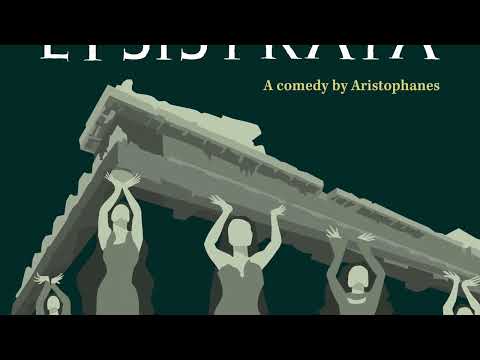
| A modern staged trailer, giving a sense of how the play still reads on a contemporary stage. Watch → |
Browse: the Perseus Digital Library at Tufts University hosts the full ancient Greek text alongside a free English translation, side by side, at perseus.tufts.edu.
|
|
|
|


