The Man Who Painted the Dark
Caravaggio“The Calling of Saint Matthew”
| R |
ome. 1599. A 28-year-old painter is broke and looking for a break. He owes his landlady six months’ rent. Last week he was arrested for carrying a sword without a licence. The week before that, he got into a knife fight outside a tennis court. |
But he has a patrona powerful one. Cardinal Francesco Del Monte had noticed his early paintings: small, dark scenes of card sharps and fortune-tellers, lit like a back-room card game. Something in them caught the cardinal’s eye. And Del Monte had real influence at the papal court.
Three paintings for the Contarelli Chapel in the church of San Luigi dei Francesi. The subject: the life of Saint Matthew.
Now, Matthew was a tax collector. In first-century Judea, that made him a traitor… a Jew collecting money for the Roman occupation. His own people despised him. Then one afternoon, according to the Gospel, Jesus walked into his counting house, pointed at him, and said two words: “Follow me.”
So he did. He stood up and walked out, leaving the coins right there on the tablethe ledger still open beside him. Twenty years of collecting Rome’s taxes… and he walked away from all of it.
That’s the moment Caravaggio chose to paint. But he didn’t paint it the way anyone expected. Before him, every painter set these scenes in golden light. Clean robes. Clouds and angels. Caravaggio put his in a dark room, dressed the figures in street clothes, and let one beam of light do the entire theological argument.
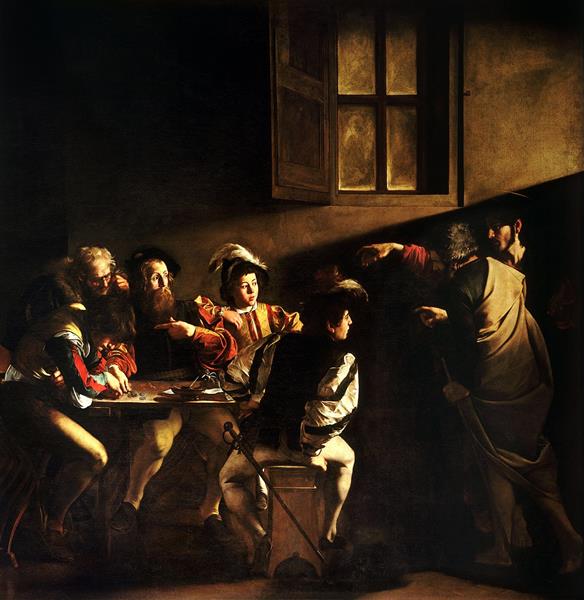
The painting is called The Calling of Saint Matthew. It’s still there. North wall of the Contarelli Chapel, San Luigi dei Francesi, Rome.
|
| Caravaggio, “The Calling of Saint Matthew,” c. 1599–1600. |
Here’s what you’re looking at.
A dark room. Five men sit around a table counting coins. Two young men in feathered caps lean in close, absorbed in the money. Nobody is watching the door.
But two figures have just stepped inside. On the far right, half-hidden in shadow, stands Christ. Saint Peter is beside him. Christ extends his arm across the room and points.
And from somewhere abovea window we can’t quite see… a single shaft of light follows his hand. It cuts across the wall and lands on the men at the table.
That light is the painting. Caravaggio lit a miracle the way you’d light a basement poker game… and left it to the viewer to decide what was sacred.
The painters who came before him used light to decorate. Caravaggio used it to choose. He gave it a job: point here, ignore everything else. The Italians had a word for thistenebrismo, from tenebroso, meaning “murky.” Most of the canvas sits in darkness. Light is the argument.
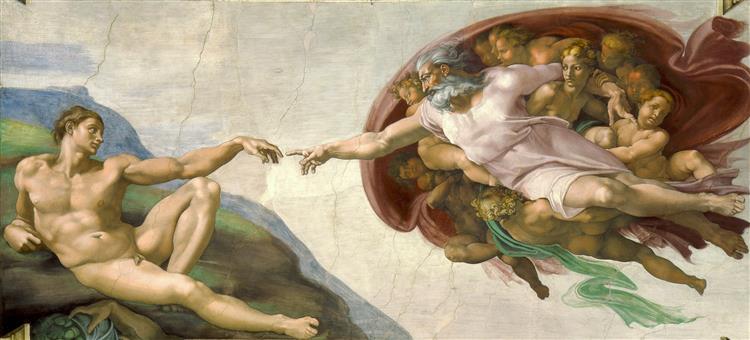
Now look at Christ’s hand. That pointing finger. He borrowed italmost exactlyfrom Michelangelo’s Creation of Adam on the Sistine ceiling, painted ninety years earlier.
|
| Michelangelo, “The Creation of Adam,” c. 1508–1512. Sistine Chapel ceiling, Vatican City. |
On that ceiling, God reaches toward Adam to spark life. Here, in Caravaggio’s version, the same gesture calls a tax collector away from his coins.
A calling is a kind of creation.
But there’s a puzzle people still fight over.
Which man is Matthew?
For centuries, everyone assumed it was the bearded man in the middlepointing at his own chest as if to say, “Who, me?” Look closer. At the far end of the table, a younger man sits bent over the money, head down. Not glancing up. Some scholars now believe he’s Matthew. The bearded man is just pointing at his young colleague.
We may never know. And that’s the point. Caravaggio froze the exact half-second before a life turns.
He didn’t have an easy one himself. Within a few years he’d killed a man named Ranuccio Tomassoni in a street fightlikely over a gambling debtand fled Rome with a price on his head. He spent his last four years running from Naples to Malta to Sicily, still painting, still brilliant, dead at 38.
I saw this painting for the first time six years ago. The chapel was empty. I dropped a euro in the light box and stood there for twenty minutes… knew nothing about tenebrism or Michelangelo’s borrowed hand at the time. But I knew this painting was different from every religious painting I’d ever half-ignored in a museum. It looked like something that had actually happened.
Rembrandt (1606–1669) picked it up in Amsterdam, fifty years later. He built his whole career on the same idea… let the dark do most of the work. So did Velázquez (1599–1660)… court painter to King Philip IV of Spain. Three hundred years after that, a cinematographer in post-war Hollywood named Gregg Toland used the same logic to shoot Citizen Kane.
So the next time someone mentions Caravaggio…
You’ll know exactly where to look.
|